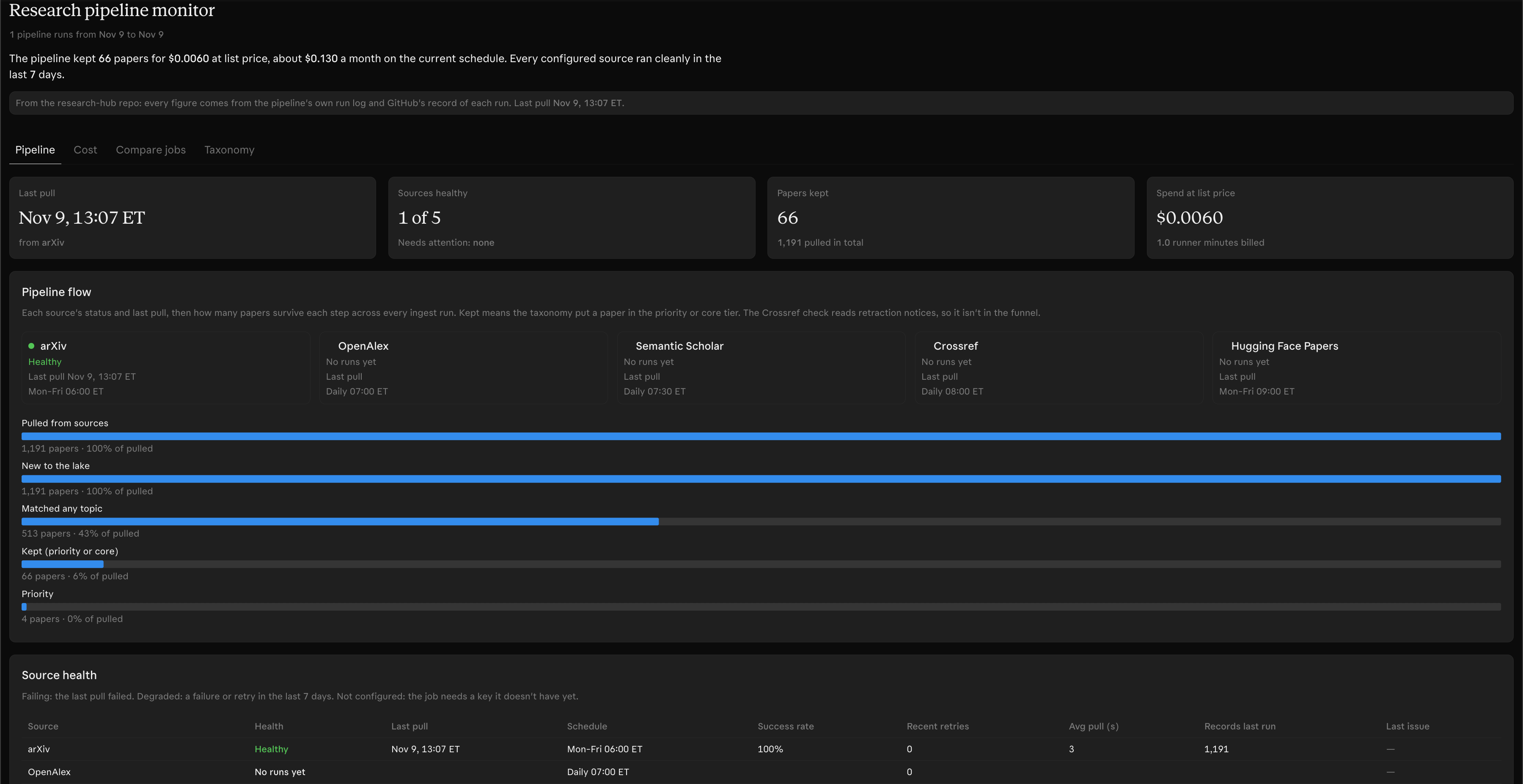
Between Nov 5 and Nov 9, arXiv posted 1,191 new papers in the 16 categories we watch. Sixty-six of them touched the problems we work on. Four were worth reading first.
We run BlueArch, a FinOps company. Our work sits where cloud bills, AI compute and data center power meet. A small team can’t read a thousand papers a week, and most of them aren’t about us anyway.
So we built a research service: scheduled jobs that read the new papers every morning, keep the few on our side of the map and set the rest aside. This post covers what it does, why we built it the way we did, and one paper it put at the top of the pile this week.
What we built
The research service is a small pipeline that runs on GitHub Actions and keeps everything as plain files in one repository. Five scheduled jobs feed it each morning:
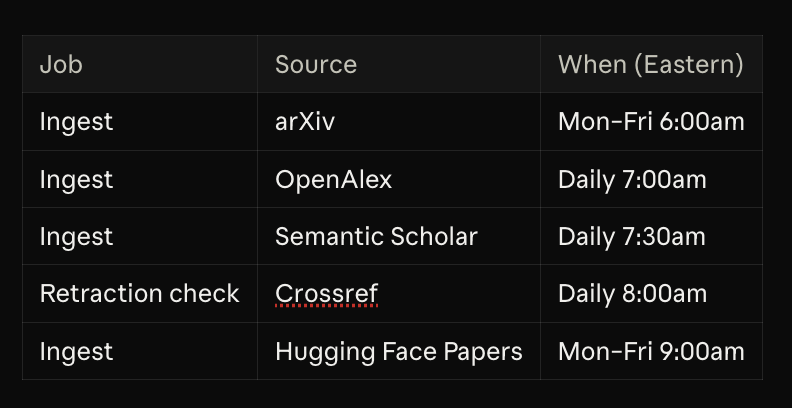
Every ingest run takes the same four steps:
Pull the new papers from the source.
Resolve them against what’s already stored, so a paper that turns up from two sources is stored once.
Gate each paper against our topic map and give it a tier.
Write the result to the lake: plain JSON files of papers and of every run.
The Crossref job works on papers already stored and flags any that get retracted. A dashboard reads the lake and shows each source’s health, how many papers survive each step, and what every kept paper cost.
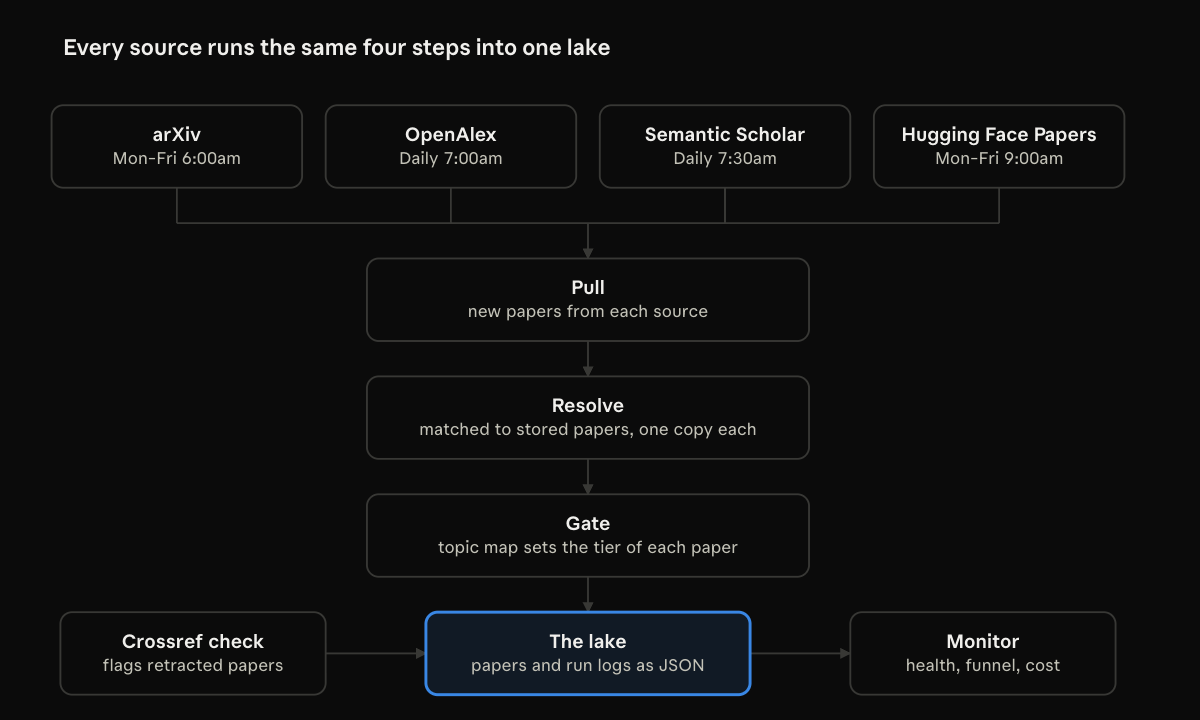
Each source runs on its own schedule into the same lake. The Crossref check flags retractions there, and the monitor reads from it.
Why we built it this way
A topic map we can read, not a black box. The gate is one taxonomy file: 9 topics in 3 domains (cloud and FinOps, infrastructure and energy, AI and emerging compute). Each topic has keywords, acronyms, terms a paper must also mention, and exclusions. When a paper is kept or dropped, we can point to the exact term that did it and fix it in one line.
The overlaps are intentional. Six bridge topics sit where the domains meet: AI infrastructure economics, AI energy and data center power, carbon-aware cloud, AI governance in the cloud, quantum in the cloud, and efficient transformers. A paper that hits a bridge, or topics from two domains, goes to the priority tier. A paper that is only about AI isn’t kept, and that is most of arXiv.
Measured from day one. Every step of every run logs records in and out, API calls, tokens and time. That lets us judge each job by what it costs per paper we keep, not per run. The first arXiv run paid no API fees and used no model tokens.
What broke in the first week. We tested the map on a week of arXiv (Oct 30 to Nov 5) and fixed it on Nov 8:
The phrase “inference cost” alone tagged 47 generic machine-learning efficiency papers as priority. Bridge topics now also need a match on a linked topic other than AI.
The acronym EMS (energy management system) matched emergency medical services, and HPC pulled in general supercomputing work. Neither counts on its own anymore.
PPA matched an unrelated method name. In energy it means a power purchase agreement; in our AWS work it means a private pricing agreement. Acronyms are where a keyword list breaks first.
What it produces
Every paper lands in one of four tiers. Here is how the first live arXiv run, on Nov 9, sorted 1,191 papers:
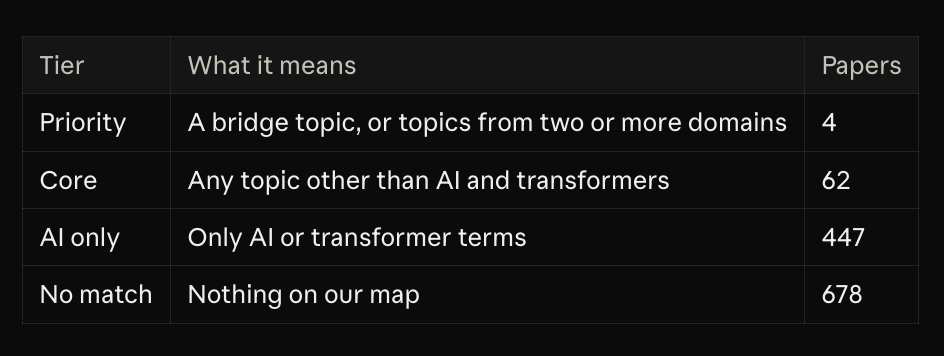
Priority and core are the papers we read: 66 of 1,191, about one in 18. These were the four priority papers that morning:
Paper
Why it’s priority
CascadeRec: Deployed Adaptive LLM Compute Allocation for Multi-Tenant Content Recommendation
Bridge: AI infrastructure economics
Two-Layer Evolutionary Scheduling for Machine Learning Jobs in Multi-Cluster Environments
Two domains: data centers and AI
AutoCompress: Automated Hardware-Guided Model Compression
Two domains: data centers and AI
Circuit Theory-Informed AI for Condition Monitoring in Power Electronics
Two domains: data center efficiency and AI
Top of the pile: CascadeRec
CascadeRec: Deployed Adaptive LLM Compute Allocation for Multi-Tenant Content Recommendation is by Kai Zhao and six co-authors. It was posted Nov 5 and is listed as an oral paper at IAAI-27. We picked it because it was the only priority paper to hit a bridge topic, and because it is about the bill, not a benchmark.
The setup. A financial planning (FP&A) software company uses large language models to rerank content recommendations for many customers at once. Running the big model on every request is expensive. So the authors built a two-tier cascade: a lightweight model reranks every request, and a router sends only some requests on to a costlier second tier.
The result in production. In an A/B test that ran for over a month, the cascade cut inference cost by about 10%. Latency barely moved, and they saw no drop in quality.
The catch. The customers’ data can’t be published, so the authors also tested on two public datasets, MovieLens-1M and Amazon-Electronics. There, putting every user through LLM reranking made results worse for users with little history, by up to 30% on a standard ranking measure (NDCG@10). Sending those users to the expensive tier made it worse still, which is why production only escalates the segments where it helps.
What we take from it.
Spending compute only where it changes the answer is a cost lever, just like a discount. Here routing was worth about a tenth of the inference bill.
More compute can make results worse for some users. Check quality by segment before you scale a model up, not just cost.
What’s next
For now the gate runs on the topic map alone. Two steps come next, and the cost tracking already has a place for both: an embedding check that compares each paper with a set of seed papers we know matter, and a model step that pulls the key facts out of each kept paper.
If this is useful, we’ll keep sharing what lands at the top of the list. And if you work on any of the bridge topics, from GPU cost to carbon-aware scheduling, send us your paper. We’d like to read it.
Sources
CascadeRec on arXiv: abstract and listing, Nov 5, 2026
Pipeline figures: our run log for the Nov 9 arXiv run and taxonomy v0.2 (Nov 8), from the research service’s own files